
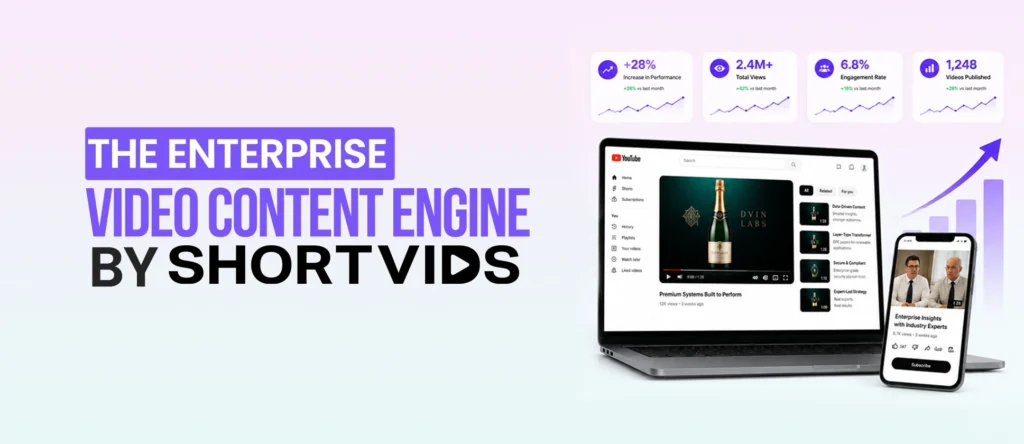
Video production in the United States is no longer limited by creativity; it is limited by speed, cost, and how fast teams can execute at scale. Online video editing services are reshaping how brands handle content by eliminating delays, reducing overhead, and enabling continuous output without relying on traditional agency structures.
The shift is not just a trend; it is backed by real numbers. The global outsourced video editing services market is valued at $2.09 billion in 2026 and is projected to reach $3.04 billion by 2032. It is growing at a CAGR of 6.4 percent due to rising demand for faster and more scalable production (Source: Research and Markets). This clearly shows how businesses across the United States are moving away from rigid local models toward flexible remote solutions.
Local agencies still operate on slower timelines and higher retainers, which creates friction for brands that need weekly or even daily content. In contrast, platforms like ShortVids are built for speed and volume, offering structured workflows and predictable monthly pricing that align with modern marketing demands.
This guide breaks down the real differences between local video production agencies and online services, covering cost comparisons, turnaround speed, scalability, and when each option makes sense for U.S. businesses looking to outsource video editing services effectively.
TL;DR: In 2026, U.S. businesses face rising demand for high-volume, platform-optimized video content, but local agencies are costly and slow. This guide compares local vs online video editing services, highlighting cost savings, faster turnaround, and global expertise. Subscription-based platforms like ShortVids help American brands scale efficiently with structured workflows.
Core Components: Clear video objectives, right provider model, cost and speed analysis, proven case studies, trial edits, client retention, niche expertise, transparent pricing, dedicated editing teams, advanced editing tools, structured communication workflows.
Outcome: Following this framework, U.S. companies can confidently choose professional online video editing services that deliver consistent quality, rapid production, and transparent pricing.
In 2026, video content drives performance across every major channel in America. Around 91 percent of U.S. businesses now use video as a marketing tool (Wyzowl), showing how essential video has become for engagement and growth. Short-form video continues to deliver the highest ROI across platforms, and landing pages with video can increase conversions by up to 80 percent.
As demand increases, many companies struggle to keep up using traditional methods. In-house teams and local agencies often face limited capacity, high overhead costs, and inconsistent output quality, making scaling difficult.
This is why brands are shifting toward monthly video editing services and subscription-based models like ShortVids. Instead of hiring full-time editors or relying on expensive agencies, companies now outsource video editing to remote teams that deliver faster, more predictable, and higher-quality results.
For U.S. businesses, cost is often the first consideration when selecting a provider. Local agencies usually charge high retainers and additional fees, while online services offer predictable subscription pricing.
Example: 10 videos per month
Faster turnaround allows brands to test campaigns quickly, optimize messaging, and improve ROI.
Pros
Cons
Pros
Cons
Remote teams work across multiple markets, giving them exposure to global trends, storytelling styles, and platform updates. This allows U.S. brands to produce content that performs internationally, not just locally.
Local agencies are often limited to regional campaigns, while global editing teams help brands stay competitive across platforms like TikTok, Instagram, and YouTube.
A remote-first editing company with global talent. It has completed 1700+ projects and generated 300M+ views for clients, offering high-end production without local agency costs.
A global e-commerce platform that relies on scalable remote creative teams to produce high-volume marketing and educational videos, proving remote workflows outperform traditional agency models.
ShortVids provides a subscription-based video editing system designed for scalability, speed, and consistency.
Produced 1,000+ videos and millions of views using structured editing workflows.
Delivered 525+ creatives across platforms, improving engagement and maintaining consistent content output.
Choosing the right video editing partner is not just about cost. It requires evaluating speed, quality, scalability, and workflow systems. Online video editing services provide faster turnaround, lower cost, and better scalability compared to local agencies.
How much do video editing services cost in the USA?
From $350/month to several thousand depending on volume and quality.
Are remote video editing teams reliable?
Yes, structured teams often deliver more consistent results than freelancers or agencies.
What is the turnaround time?
Typically 24–48 hours for drafts and 1–3 days for final delivery.
Does video editing improve marketing performance?
Yes, it significantly increases engagement, conversions, and brand visibility.